
Overall height
Bottom of the base to the top of the lamp, the number most listings give.
The table lamp size guide
Nightstands, side tables, consoles and desks.
A table lamp is sized for the person sitting beside it and the table it has to share. This guide gives starting heights for a nightstand, a living room side table, a console and a desk, then shows where the bottom of the shade should sit. Keep the full shade on the tabletop, with room left for a book or a glass.
The sightline
The bottom of the shade should meet your eye line. That hides the bulb and puts the light on the table, the page or the work in front of you.
A seated person beside a table lamp. The bottom of the shade lines up with the seated eye line.
The drawing shows the relationship, not a scale model. Seated eye height from the floor, minus table height, is the shade-edge target above the tabletop.
Three heights
The same table can hold three different lamps. Only one puts the bottom of the shade on the seated eye line.
Three lamps on the same table. The middle shade meets the seated eye line. The tall shade sits above the eyes. The short shade sits below them.
Measure from the floor to your eyes while seated, then subtract the table height. That number is the shade-edge target, not the lamp’s total height.
Start here
Sit where you’ll use the lamp. The bottom edge of the shade should land at about your eye level, so the bulb stays out of your direct line of sight. Starting overall heights are 24–27 inches beside the bed, 24–32 inches in the living room, 26–32 inches or taller on a console, and 18–28 inches on a desk.
Then check that the whole shade fits on the tabletop, with room left for a book, a glass or a phone. Lamp listings use three different measurements. Keep them apart.
Bottom of the base to the top of the lamp, the number most listings give.
How far the bottom of the shade sits above the tabletop. This is the one that decides glare, and it is often not listed.
The widest point of the shade, which is usually wider than the base footprint.
Seated eye height minus table height. Work it out in the calculator below.
Four places a lamp lives
Each room uses the same two checks, your seated sightline and the usable tabletop, but the furniture changes the answer. These are starting points, not four boxes you have to fit into.
Reading height & a clear nightstand

Sofa height & a drink table that still works
The whole wall & ambient light

Light on the work, not in your eyes
At a glance
| Room | Starting lamp height (overall) | Check first | An easy first move |
|---|---|---|---|
| Bedside | 24–27 in | Your eye height sitting up in bed, and the nightstand height | Measure the nightstand, then choose a lamp that brings the shade edge near your seated eye line. |
| Living room | 24–32 in | Your eye height on the sofa, and how the side table compares with the sofa arm | Start in the mid-20s and check that the shade fits the table with room for a drink. |
| Console and buffet | 26–32 in, or more on a long buffet | The mirror, art or window above, and the furniture’s width | Choose one lamp with presence, or a matching pair, and keep it clear of what hangs above. |
| Desk | 18–28 in | Your eye height in the desk chair and the space you need to work | Choose a narrow base or an adjustable shade and test where the light lands. |
These are starting ranges for overall lamp height, in inches. They don’t confirm that a particular lamp will fit. Dimensions, shade size, bulb requirements and switches vary by product, so check the product page before ordering.
01 / Size for the room
Reading height & a clear nightstand
A bedside lamp has two jobs. It lights a book without shining in your eyes, and it leaves the nightstand usable for a phone, a glass and whatever you fell asleep reading. Start by sitting up in bed against the headboard. Measure from the floor to your eyes. Then measure the nightstand. A nightstand that sits within a few inches of the top of the mattress is easiest to light well and easiest to reach.
A low nightstand may need a taller lamp to bring the shade up to reading height. A tall nightstand may need a shorter one. Two lamps of the same height can land in different places depending on the table below them.
When you’re sitting up, the bottom of the shade should be close to eye level. If you can see the bulb from the pillow, the shade sits too high or is too shallow.
Keep the full shade inside the nightstand top, and leave room for a phone and a book. A narrow nightstand usually suits a slimmer shade or a compact lamp.
Bedside light is used close up, at a low seated height, often by two people with different eye lines. Measure each side if you share the bed.
Use the quick sum with your own numbers. If your eye height sitting up is 40 inches and the nightstand is 26 inches, look for a lower shade edge around 14 inches above the tabletop. Then compare that with the lamp’s shade-bottom measurement or dimension drawing, if the product page has one.
Check dimensions, materials, bulb requirements and care on each product page before ordering.

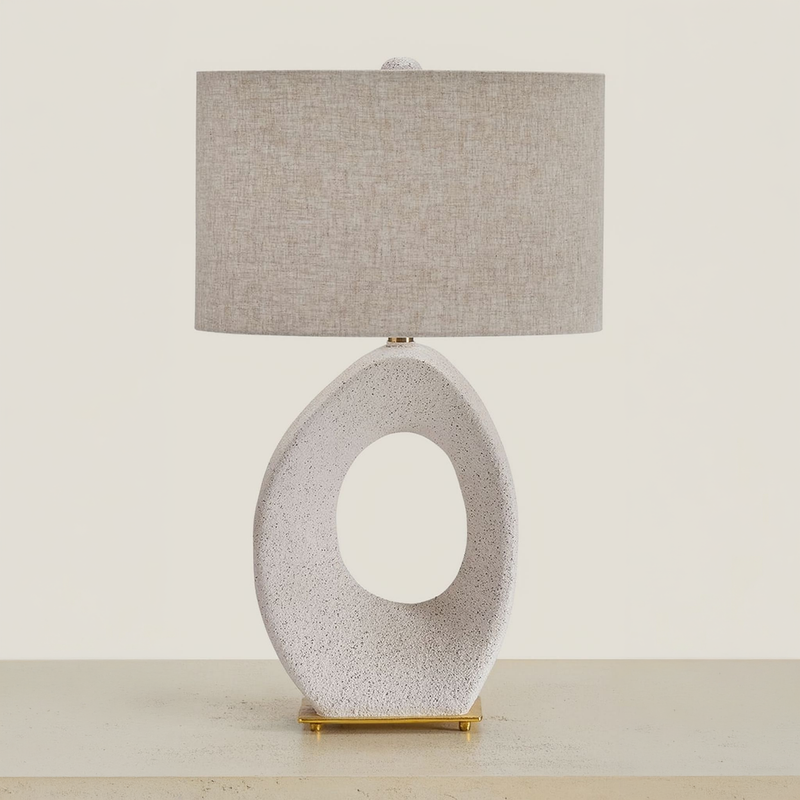
Listed at 24.75 inches tall and 15 inches wide, at the start of the bedside range. Warm sand-toned resin base with a pressed honeycomb relief whose texture shifts with the light. Paired with a deep charcoal drum shade.

25 inches tall with a 13.5-inch shade diameter. Sculptural cream resin arch-form base with a tapered linen-toned shade. A slim footprint for a nightstand with limited surface.

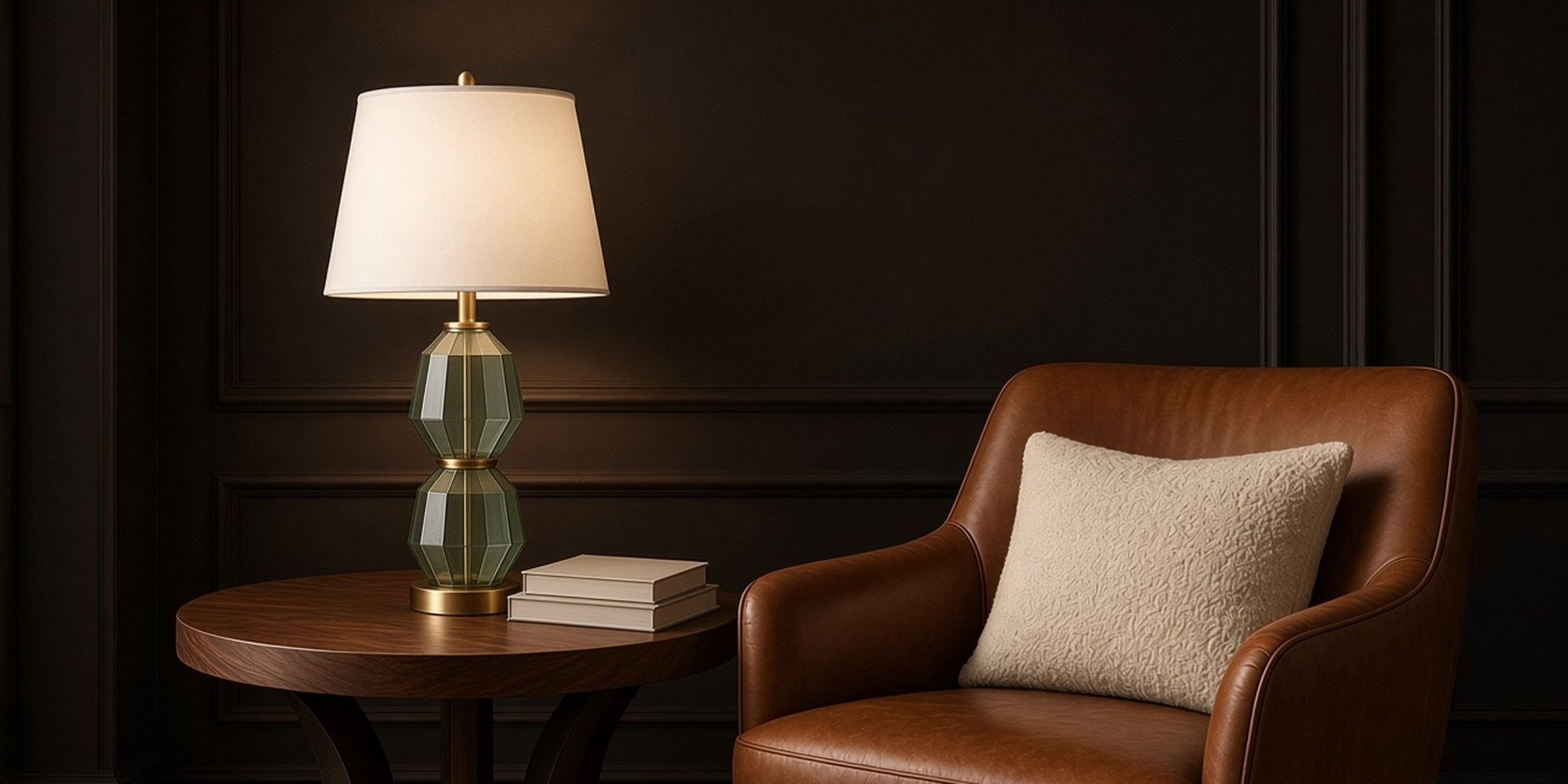
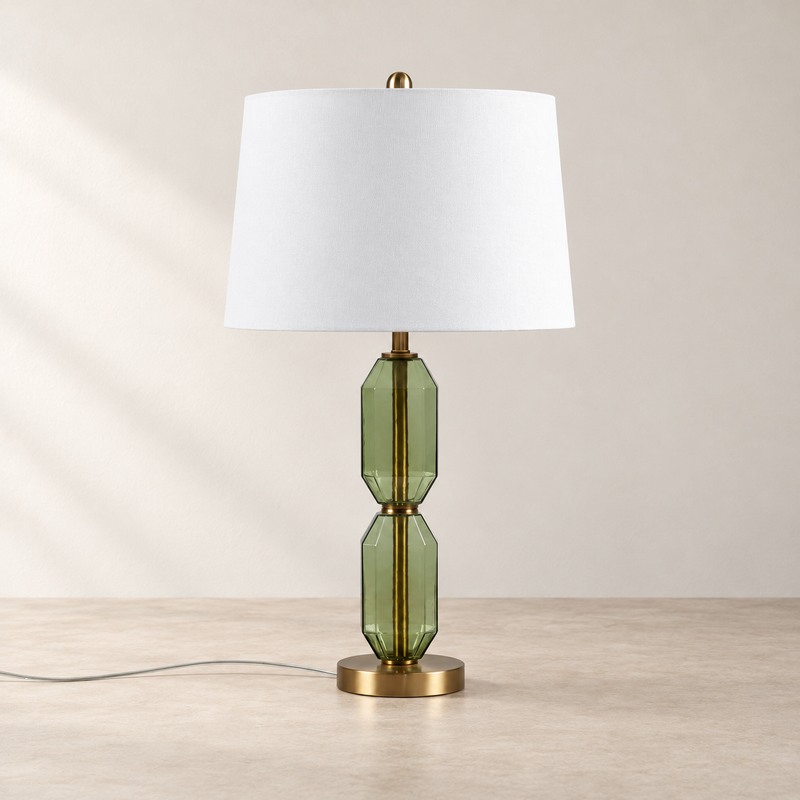
26 inches tall and 15 inches wide. Faceted matte olive-green ceramic base with a brushed brass collar and ivory linen drum shade. A 3-way rotary switch lets you set light level from reading to ambient. Check that the 15-inch shade fits the nightstand with room to spare.
02 / Size for the room
Sofa height & a drink table that still works
Beside a sofa or reading chair, the lamp is part of the seating. Sit where you normally sit and measure from the floor to your eyes. Side tables that are about level with the sofa arm, within a couple of inches, are the easiest to reach and the easiest to light. Many designers find that the table and lamp together land somewhere around 58 to 64 inches from the floor. Treat that as a cross-check, not a rule. Your eye line still decides.
A deep, low sofa puts your eyes lower than an upright armchair does. Measure from the seat you’ll actually use.
A substantial sofa can carry a lamp with more visual weight, but a small drink table still needs a modest footprint. The shade should stay within the tabletop.
A lamp that looks fine from the sofa can look tiny next to a large sectional. If it disappears, try a taller base or a broader shade that still fits the table.
Living room lamps are seen from several angles and used for reading, conversation and evening light. You have a little more freedom than at the bedside, as long as the bulb stays hidden from the main seats.
Put a stack of books on the side table to the height you think the lamp base should reach, then sit down. It’s a free way to test height before you order anything.
Check dimensions, materials, bulb requirements and care on each product page before ordering.

26 inches tall and 15 inches wide. Rectangular marble-finish base with a warm antique brass-tone ring and tapered fabric shade. Leave room for a drink beside that 15 inches.

26 inches tall on a 13.5-inch footprint. Walnut-tone wood cone base with a brushed brass collar and cream drum shade. For a side table that can carry some warmth.

A black bottle-shaped ceramic base with a deep black drum shade. Listed at 24 inches high and 15 inches wide, with a 15-inch shade over a 7.75-inch base.
03 / Size for the room
The whole wall & ambient light
A console, sideboard or buffet lamp is mostly about the room, not about reading. People walk past it rather than sit beside it, so glare matters less and proportion matters more. Look at the furniture’s width and at whatever hangs above it. A long buffet can handle a taller lamp, or a pair. A narrow entry console usually wants one lamp with a slim footprint.
Stand back and check that the shade doesn’t crowd or cover a mirror, artwork or window frame above the console.
A single lamp on a long buffet can look stranded. Two matching lamps, one toward each end, are a common way to balance a long surface. One lamp plus a stack of books or a bowl works too.
Consoles are often shallow. Check the lamp’s depth and full shade width against the tabletop so the shade doesn’t hang over the front edge where it can be bumped.
Most consoles are taller than side tables, and nobody is sitting beside them. That’s why the starting range runs higher and the eye-line rule relaxes.
Tape a sheet of paper to the wall at the height where the top of the shade would reach. Step back to the doorway. If it covers the bottom of the mirror or art, go shorter or move the lamp toward the end of the console.
Check dimensions, materials, bulb requirements and care on each product page before ordering.

26.25 inches tall on a 15-inch footprint, at the start of the console range. Geometric matte gold metal lamp with a fabric drum shade. Check from the doorway that the shade fits within the console's depth.

A stacked marble and clear acrylic base with a cream drum shade. 28.5 inches tall on a 15-inch by 15-inch footprint. The listing suggests it as a standalone lamp or a symmetrical pair.

Five alabaster slabs on a square brushed-gold base, with a white drum shade. 26.7 inches tall with a 15-inch diameter.
04 / Size for the room
Light on the work, not in your eyes
A desk lamp is a work light. It should put light on the page or keyboard without shining into your eyes or onto the screen. Sit in your desk chair and check two things: where your eyes are, and how much desk you actually need clear. An adjustable or directional shade gives you more control than a fixed drum shade, and a narrow base leaves more room for the work itself.
Sit down and look across the desk. If you can see the bulb, lower the shade, angle it down or choose a shorter lamp.
If you write by hand, place the lamp on the side opposite your writing hand so your hand doesn’t cast a shadow across the page.
Aim the light at the desk surface rather than the monitor. A tilting shade helps.
Desk lamps are used close to the face for long stretches, so glare control matters more here than anywhere else in the house.
Sit at the desk with a book open where you’d normally work. Hold a tape measure upright beside it and note where your eye line crosses. That’s roughly where the bottom of a fixed shade should sit.
Check dimensions, materials, bulb requirements and power details on each product page before ordering.

A compact architect-style lamp with a swing arm, a pivoting shade and a three-level touch dimmer. The base doubles as a wireless charging pad. Available in black, brass and satin nickel.

A directional LED desk lamp with a curved gooseneck arm, a tilting shade, three selectable color temperatures and wireless charging in the base.

A cream metal lamp with a dome shade that tilts to aim the light, on a compact footprint. Check where the light falls at the angle you’ll use.
From above
If you write by hand, the lamp belongs on the other side of the page so your hand does not fall across the light.
A top-down desk. The lamp sits on the left and the writing hand sits on the right of the page.
If you mostly type, keep the lamp off the screen and aimed at the desk surface.
The finishing proportion
Sometimes the height is right and the lamp still looks off. It’s usually the shade.
For a conventional shaded lamp, a shade height of about two-thirds of the base height is a useful starting point. Treat it as a visual check, not a formula.
The shade should generally be wider than the base, but it should stay within the tabletop. Measure the full shade width, not just the base footprint. A shade that hangs over the edge is easy to bump and takes over the table.
Sit where you’ll use the lamp. The shade should hide the bare bulb from your usual sightline. Globe, glass and directional lamps don’t hide the bulb the way a drum shade does, so test them from your seat.
From above
Compare the full shade width with the tabletop. The shade should sit inside the top and still leave room for a glass.
A shade wider than the table hangs past the edge. A shade that fits leaves room for a glass.
Measure the shade at its widest point, not only the base.
A lamp, one measurement at a time
Leave with three numbers: a starting lamp-height range, a lower shade-edge target, and the widest shade your tabletop can take. These five steps get you there, using the furniture you already have.
Note its height, width and depth. Decide how much surface you need for everyday things.
Sit on the sofa, in the desk chair or upright in bed. Measure from the floor to your eyes.
Subtract the table height from your eye height. That’s how far above the tabletop the bottom of the shade should sit.
Subtract the space you want to keep clear from the tabletop width. A shade wider than what’s left will crowd the table.
Compare overall height and shade width with your notes. Confirm the shade-bottom height from a dimension drawing if there is one, and check bulb type, switch, cord length and dimmer compatibility on the product page. If a measurement isn’t listed, write it down as a question to confirm before you order.
The quick sum
Subtract the table height from your seated eye height. The result is how far above the tabletop the bottom of the shade should sit. It is not the lamp’s total height.
Example: 40 inches seated eye height − 24 inches table height = a 16-inch target for the lower shade edge above the tabletop. This is not the lamp’s total height.
Compare the result with a shade-bottom measurement or a dimension drawing when the product page has one. For globe and directional lamps, check the glare from the seat where you’ll use the lamp.
Before you choose
Use the lamp you’re considering. If a measurement is missing, write it down as a question for the product page.
A few good questions
A lamp in the mid-20-inch range is a useful starting point. Sit beside it and aim for the bottom of the shade to fall near your eye line. The lamp’s total height isn’t the same as the height of its lower shade edge.
It can be. The combined height matters more than which piece is taller. A low nightstand often needs a taller lamp to bring the shade to a comfortable reading height.
Wider than the base, and narrower than the table it sits on, with room left for everyday things. On a narrow nightstand or shallow console, a slimmer shade or a compact lamp is usually easier to live with.
It’s usually better if it isn’t. A shade that extends beyond the table can look top-heavy, takes away usable space and is easier to knock.
No. Different lamps can look intentional when they share a similar shade height, finish, material or visual weight. Look at the pair from across the room as well as from the bed.
Consoles are usually taller than side tables and nobody sits beside them, so you can start in the high 20s to low 30s. Check what hangs on the wall above and keep the shade within the console’s depth.
Start in the 18- to 28-inch range and test from your chair. An adjustable or tilting shade lets you aim light at the work and keep the bulb out of your eyes.
High ceilings don’t automatically call for tall lamps. A large room and substantial furniture can carry more visual weight, but the tabletop and your seated sightline still matter most.
Find the pieces
Take your height range, shade-edge target and shade-width limit with you. These links open the current assortment, so check dimensions, materials and bulb details on each product page before ordering.
Lamps for nightstands, where reading height and a clear surface matter most.
Lamps for side tables beside a sofa or chair.
Lamps for sideboards, entry consoles and long buffets.
Adjustable and directional lamps for work surfaces.
The full table lamp collection.
Leave room for the bed, bedside furniture and everyday movement.
Review current shipping information before ordering.